In the course of my years of ministry as a deacon I have had many people ask me to pray for them, especially when they were in a time of crisis. Frequently, this has included prayers for physical healing when someone has been diagnosed with a serious illness. To be open and honest, I have sought this type pf healing in my own life when I have been facing serious illness. As I look back now and reflect through my spiritual journey which has included cancer twice and open heart surgery as well, I have come to distinguish the difference between a desire for a physical cure and a desire for true healing.
Jesus cured people of physical illness during his ministry on earth; the accounts of these episodes are laid out for us in the Sacred Scriptures. As I have studied the Scriptures lately I seem to be more drawn to the healing component of a variety of these encounters depicted for us. The healing touch of Jesus goes much deeper than the physical cure of a particular malady. God wants to bring us the fullness of healing; we are blessed indeed.
As we prepare for the season of Lent, let us reflect upon our baptismal call to holiness. Are we responding to God’s call with zeal and enthusiasm? Do we seriously yearn for the light of Christ to shine in our lives? My concern is that we can easily grow complacent if we are not diligent in making our relationship with Christ a priority in our lives. There are plenty of other things that scream for our attention. If we are not watchful, the devil will not only prowl about the world seeking the ruin of souls, he will pounce upon the opportunity when we are not alert. Turning away from sin and remaining faithful to the Gospel requires diligence on part so that we walk in God’s grace.
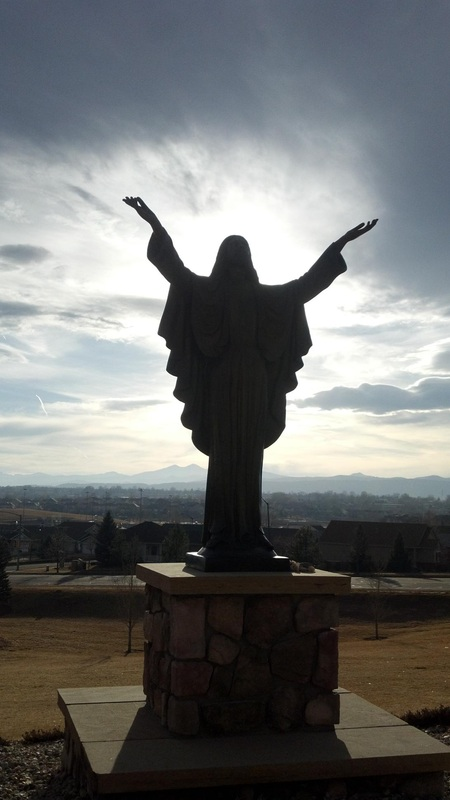
The picture above was taken on Valentine’s Day in front of St. Elizabeth Ann Seton Church in Fort Collins, Colorado. It almost appears that the clouds opened up at the right time for the picture to be taken. In reality, the love of God dispels the darkness each and every day of our lives. We are children of light. Let us live faithfully in that light!
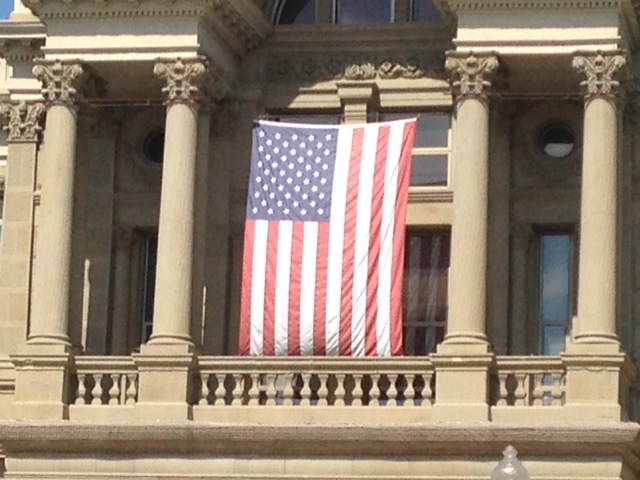
I am going to run the same post I ran last year for President’s Day with just a few edits. I will adjust the number of years abortion has been legal and also mention Brittany Maynard under the part about physician-assisted suicide. I believe the experiences of this past year have simply solidified the thoughts I expressed last year. We are losing our religious liberties one step at a time at all levels of government. It seems to me that one of the greatest blessings of this holiday weekend is that the state legislators didn’t meet today and they adjourned to enjoy a four day weekend. Our liberties are much safer when the legislators are not in the capitol building.
As we approach another celebration of “President’s Day” on Monday I can’t help but wonder what President Washington, President Lincoln, and all of our Founding Fathers would think about the current state of affairs in our country. It is evident that Christianity in Colonial America served as the foundation of everything the early settlers set out to do. The collapse of Christian virtues and values in our modern culture shows just how far we have strayed from the original intent of our country’s founding.
The Rhode Island Charter of 1683 begins, “We submit our person, lives, and estates unto our Lord Jesus Christ, the King of kings, and Lord of lords, and to all those perfect and most absolute laws of His given us in His Holy Word.” Fast forward nearly 100 years to 1779 and look at what Samuel Adams wrote in a letter to James Warren. “A general dissolution of principles and manners will more surely overthrow the liberties of America than the whole force of the common enemy. While the people are virtuous they cannot be subdued; but when once they lose their virtue, they will be ready to surrender their liberties to the first external or internal invader. How necessary then is it for those who are determined to transmit the blessings of liberty as a fair inheritance to posterity, to associate on public principles in support of public virtue.” It seems that Samuel Adams had in mind in 1779 what we would witness in our current generation.
Noah Webster (1758-1843) published a textbook in 1832 entitled, History of the United States. In this book he speaks at length about the value of religion, the Bible, and Christian principles. One line serves as a prominent reminder to all public servants today. “Almost all the civil liberty now enjoyed in the world owes its origins to the principles of the Christian religion.” Compare that statement to the reality of today in which there appears to be an all-out assault on Christianity from the powers that be. How did we as a nation allow ourselves to be led astray from such convictions?
The moral decline of our nation is evident. The refusal to believe in Eternal Truth has brought about rampant relativism in which each individual creates his/her own truth. The consequences of such a belief system seems to become more and more obvious with each passing day. We have been legally killing unborn children for 42 years; there are times when this includes infanticide as depicted in testimony at the trial of Dr. Gosnell. Physician- assisted suicide and euthanasia clearly establish that the value of life is determined by functionality. Brittany Maynard may have considered it to be “Death With Dignity,” but a close examination of this type of process reveals some major flaws in that way of reasoning. The dignity and sanctity of human life is ignored in each of these actions, and yet, it has become accepted and even welcomed in contemporary culture. Brittany Maynard has put the discussion front and center once again. It will simply be a matter of time before more and more states welcome this practice into their boundaries.
The attack on Christianity is to be expected. People with religious convictions who are guided by the grace of Lord, Jesus Christ, the love of God the Father, and the power and communion of the Holy Spirit in their day-to-day lives are a roadblock to those with an evil agenda. The tyranny that erupted at various times in history provides us with some insight as to what is happening today. If we are prudent we will all become students of history to get a glimpse at our future. The removal of God from our public institutions, the indoctrination of students from preschool through the ultra-liberal university years, the control of the press from graduates of these liberal universities, and big time financial donors promoting their aggressive agenda paints a picture that is not too bright for Christians who value the liberty provided by God and reinforced by the Constitution of the United States of America.
The Health and Human Services (HHS) mandate is one of the latest assaults on Christianity, and on the Catholic Church in particular. Why is this relevant? The Catholic Church is a significant roadblock to those who pursue a culture of death. A book entitled, They Fired the First Shot 2012, spells it out quite clearly beginning on page 562 where the author says:
“If you study communist takeovers and dictatorships, you will see we are on this road. Mexico’s history in the early part of the last century is proof. As in Mexico, the Catholic bishops, priests and religious in the United States will be among the first to be imprisoned or killed. Others will follow. The healthcare mandate first attacks the Catholic Church. Bishops, as the enemy sees them, are generals to be eradicated to scatter the flock and are the first that must be taken down. Don’t want to believe it? Study history. Look at the French Revolution. The guillotines ran non-stop. Not possible in the United States? If there is not a radical stand now, “the guillotines,” whatever that might be in the USA, will run non-stop. History clearly shows religion is first in line to be crushed and the first major blow to smash the Church is the healthcare mandate.”
The author is adamant that the Catholic Church has to be firm in standing up against this attack on religious liberty. The writer goes on to elaborate that, “twenty-five percent of all medical health related care, totaling $100 billion, is under the spiritual authority and protection of the Catholic Church. This in itself is authority not to bargain with, but to mandate; not to request with, but to state: ‘Our goal is we will not shut down. We will not relinquish our authority to the state. We will not go to jail.’”
It appears that people of faith will need to follow the example of repentance as demonstrated by the people of Nineveh to bring our nation back to God. Prayer and fasting are key elements that people of God have used in the past and they are certainly pertinent for our needs today. May each of us truly turn our hearts and minds to God!
The words attributed to Patrick Henry so long ago may resonate once more with Americans, “Give me liberty, or give me death.”
Are you prepared to launch into Lent with gusto? We are less than a week away from Ash Wednesday. Start planning now if you have not already done so. How will you pray, fast, and give alms? There are many helpful hints on the internet and other places about how to make your Lent a holy and fruitful time. Please don’t let these precious days slip by without growing in your relationship with Jesus Christ.
What does your prayer life look like right now? How would you like it to look? Spending time each day in prayer is essential for us to grow in union with God. Our earthly relationships require spending time with one another if they are to grow and mature; the same is true of our relationship with God. Plan now to enrich your prayer life during Lent. What do you need to do to more fully open yourself to God’s grace? Do you have a set time for prayer each day? Do you have the discipline to maintain that commitment? What role does the Bible play in your prayer life? Do you allow God to speak to you as you read and meditate upon the Sacred Scriptures? Are you fond of any particular devotions? Will the Stations of the Cross be part of your prayer life during these 40 days?
From what will you fast? Certain items typically make the list–alcohol, nicotine, candy, chocolate, ice-cream, etc. In addition to our favorite sweets and treats, will we make a commitment to fast from gossip, profanity, and other hurtful behaviors? Will we refrain from watching questionable movies or television shows? Are we willing to seriously look at anything and everything to evaluate if it is bringing us closer to God or if it is driving us farther away?
How will we serve others during these days? Giving alms isn’t simply about giving money; it also challenges us to give of ourselves. How will we build up the Kingdom of God by being a faithful witness to those around us?
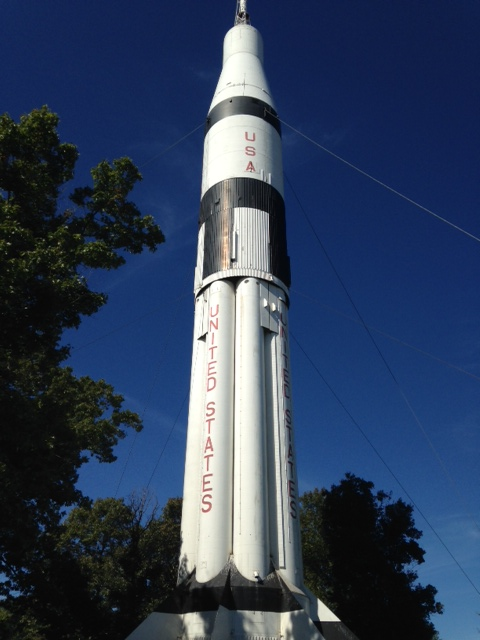
Finally, the season of Lent gives us the opportunity to develop good habits that last a lifetime. We aren’t simply embarking on a 40 day sprint. We are engaging in the first leg of the journey which lasts a lifetime and beyond. Plan now to rocket yourself into a splendid Lenten season!
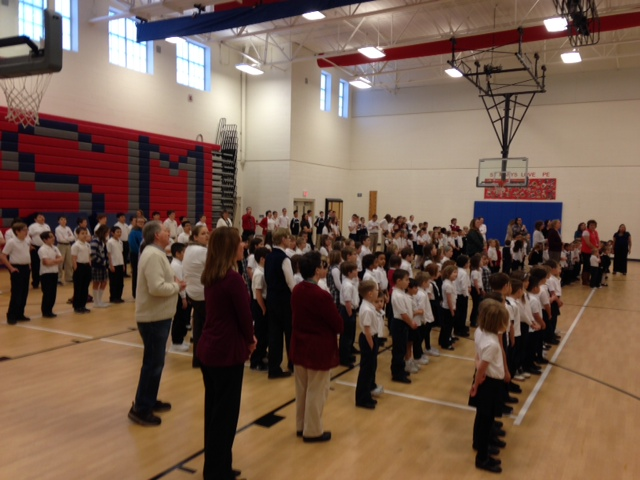
Catholic Schools Week is in full swing. I had the pleasure of stopping by St. Mary’s School in Cheyenne on Monday for the opening prayer service. Although there are only seven Catholic schools in the state of Wyoming, it requires 1,200 miles of driving to see them all. One year I visited all seven schools during Catholic Schools Week, but I tend to spread it out a little more now than before.
This weekend I will travel to Holy Name Parish in Sheridan to preach at all of the weekend Masses and close out Catholic Schools Week. I will also be closing out their year long celebration of marking their school’s 100th anniversary. Holy Name School began in 1914 and last year during Catholic Schools Week they began their year long celebration marking this milestone. Now that we have completed the year 2014 and moved into 2015 the anniversary celebration will draw to a close.
Although Catholic Schools Week will be over, I plan to visit St. Anthony’s Tri-Parish Catholic School in Casper on Monday as I make my trek from Sheridan back to Cheyenne. Traveling across the state during the winter is always a bit of a gamble. Snow is in the forecast for the weekend, but I am hoping it does not hinder my travel plans.
To all of the pastors, principals, teachers, and support staff at our Catholic schools I simply say, “Thank you.”
I want to thank Matthew Potter for providing some pictures from the events this past weekend in Cheyenne.
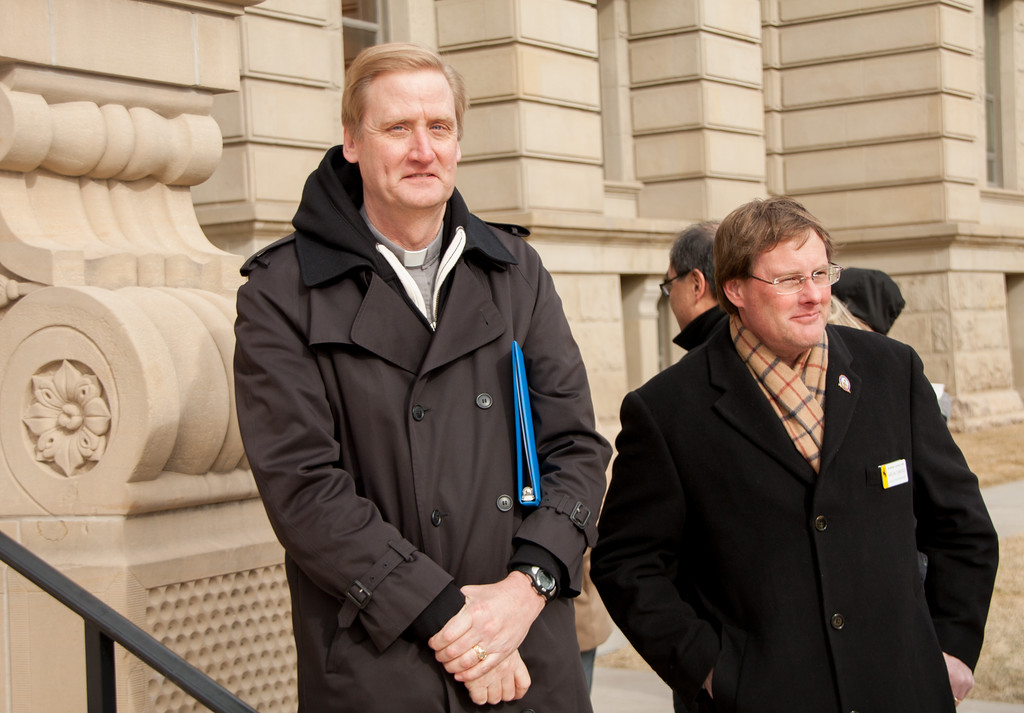
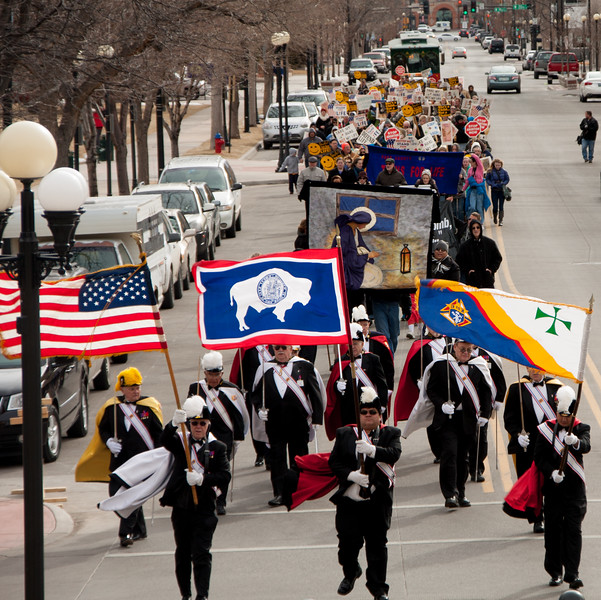
Bishop Paul Etienne was present for the march. Following him is Dr. Kevin Roberts with his family. Dr. Roberts is the president of Wyoming Catholic College.
I shared the speaking platform at the state capitol with Representative Harlan Edmonds.
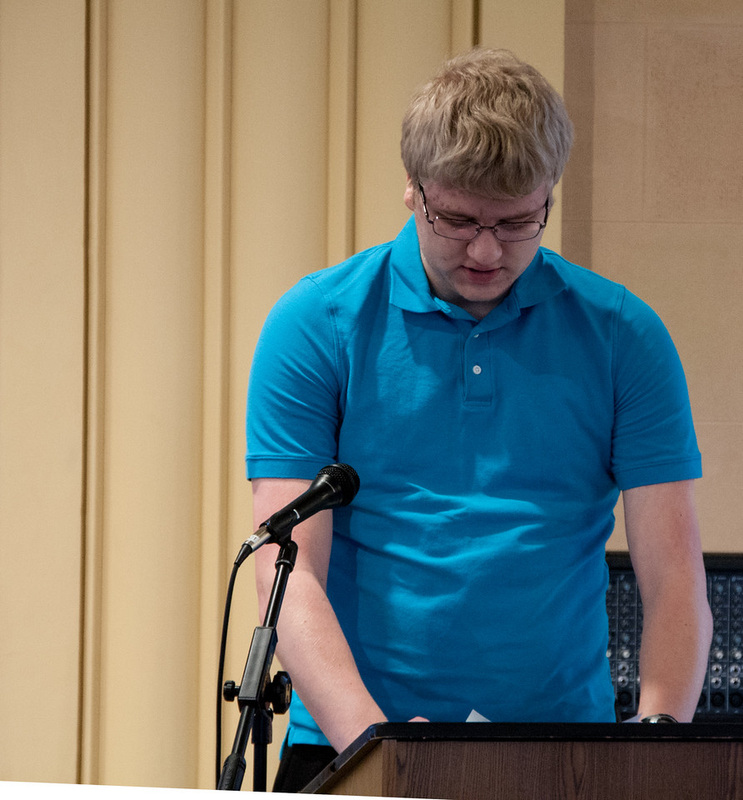
Joe Dobelmann was the winner of the senior high essay contest. I share his dilemma of speaking when the microphone is too low.
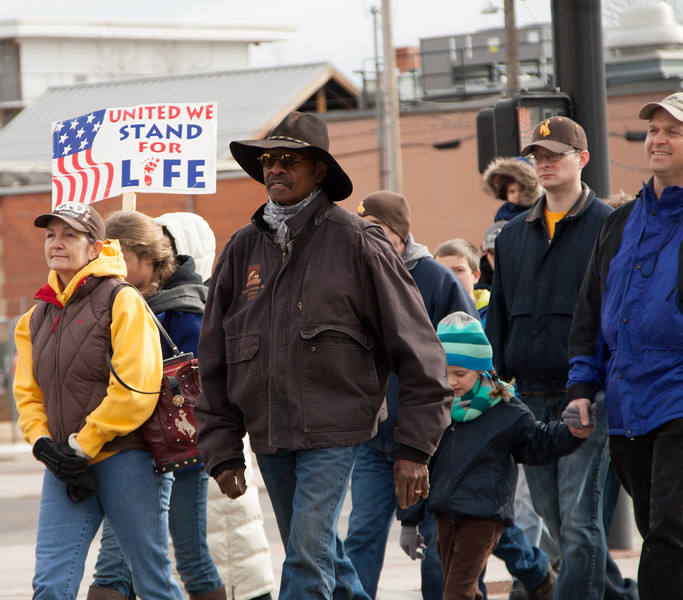
Dr. Taylor Haynes, former candidate for governor, was on hand for the march.
The Knights of Columbus did a fantastic job as always. See the flags standing straight out. Those guys built their muscles carrying the flags in the gusty winds.
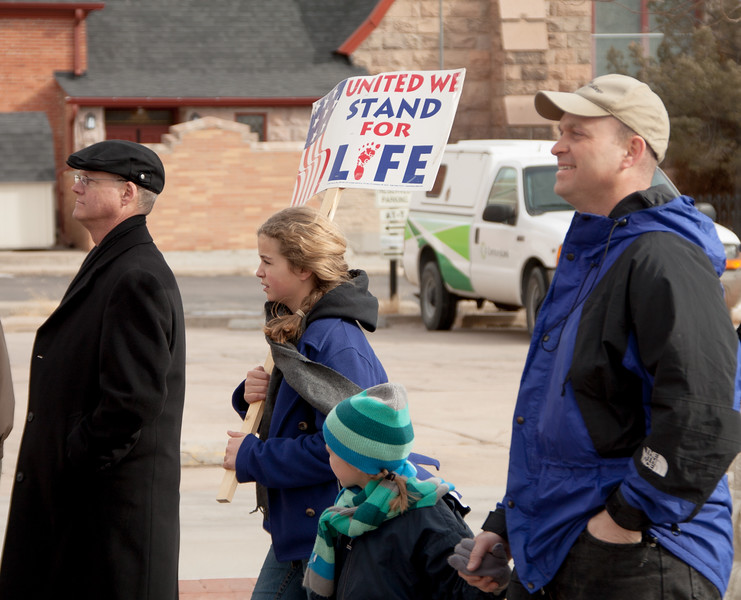
The sanctity of life was celebrated well this weekend. The Cathedral of St. Mary hosted a holy hour on Friday evening in which Catholics from all over the state gathered to pray for the protection of the unborn. On Saturday morning we gathered for the celebration of the Eucharist, enjoyed breakfast together, and then participated in the march to the capitol at noon.
In the midst of all of the activity, I forgot to take pictures. However, media outlets from across the state covered the story.
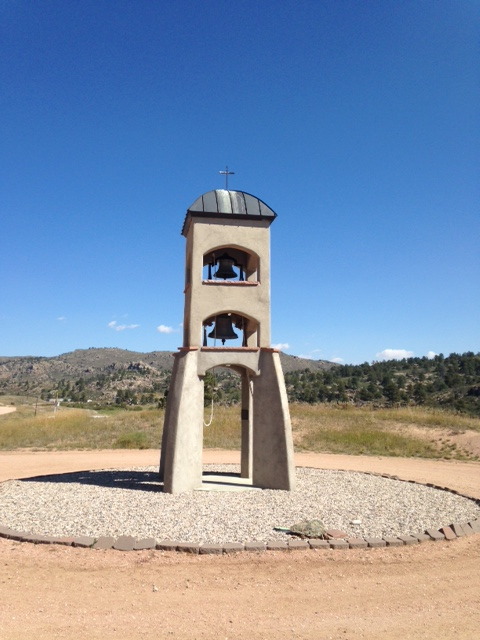
For whom does the bell toll? Since January 22, 1973 it has tolled for an estimated 56 million children here in the United States of America. It has been 42 years since that disastrous Supreme Court decision, and our supposedly civil society still allows the slaughter of the innocents unabated. This should be keeping all of us awake at night.
The politicians love to use the line, “I am personally opposed to abortion but I don’t want to inflict my views upon others.” Hogwash! There is a moral dimension to everything that is legislated. If good people check their morals at the door when they walk into the statehouse, who does that leave to set the agenda, the tone, and the tenor of discussions? We are reaping what we have sown. God have mercy on us all.
Today is a day of penance. Unfortunately, the majority of Christian people will not even see this day as a blip on their radar screen. Where is the awareness? Where is the sorrow? Where is the repentance? How can people of faith stand in complacency with the horror of abortion surrounding them? I beg you–read the statistics from a pro-life website. Millions of babies are being killed and a multitude of women are experiencing the detrimental emotional effects of their decisions. We have over 40 years of empirical evidence which shows the devastating consequences on women who choose to have abortions. If we are pro-woman, we should want to help prevent such suffering.
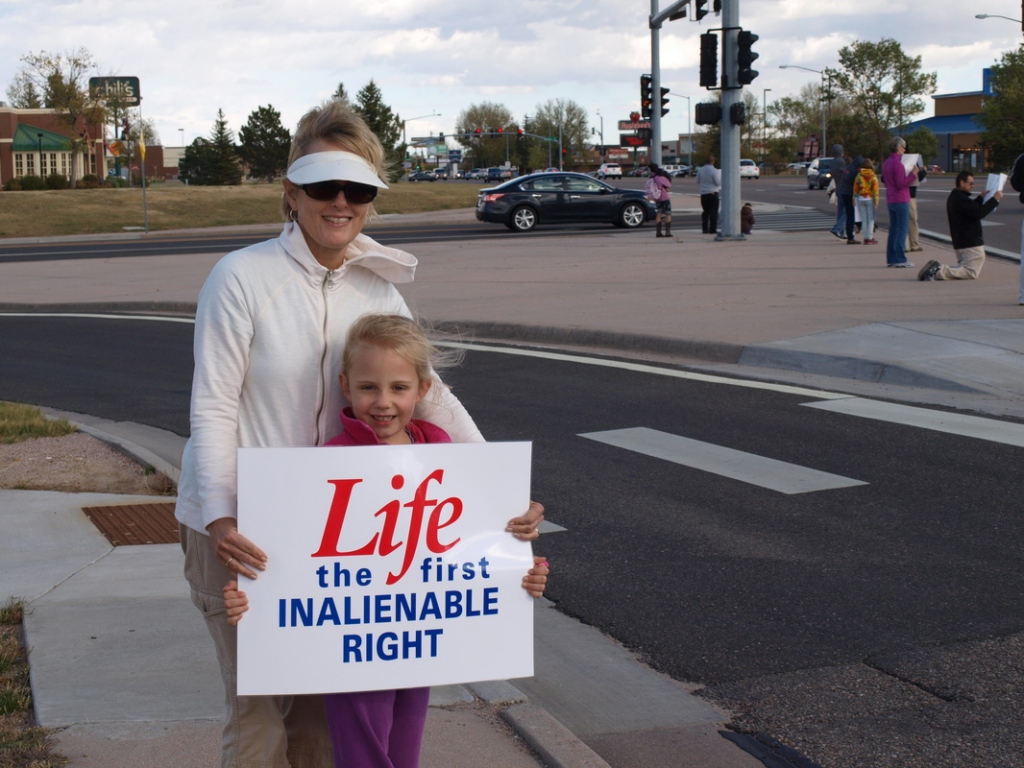
On Friday morning I will join Gary Freeman on KGAB Radio (650 AM) at 9:10 A.M. to discuss the upcoming pro-life march here in Cheyenne on Saturday at noon. I know that will result in new criticisms with people telling me to mind my own business. I have become accustomed to those comments. What bothers me is when I get those types of comments from people within the Church. How is it possible that with all of the medical technology available to give us a window into the womb, we still don’t see a problem with dismembering a baby and terminating his/her life at will? How can we call that health care? When did pregnancy become a disease to be cured rather than a joy to be celebrated?
On Saturday afternoon after the march reaches the state capitol, I will be one of the speakers to address the crowd. Please offer a prayer for me as I prepare my remarks for that day. Although the crowd in attendance will be pro-life, the reporters who will take the story to the wider public may not necessarily share the same perspective. It is important that the speakers convey a message that is clear, concise, and moving. These opportunities to get the pro-life message out beyond the walls of churches into the secular world is something that needs to be grasped with vigor.
Let us continue to strive to build a culture of life!
On January 22 (tomorrow), the anniversary of the U.S. Supreme Court decision, Roe vs. Wade (1973), all dioceses of the United States shall observe a Day of Prayer for the Legal Protection of Unborn Children. I want to invite each and every one of you to fast and pray. Our nation needs healing.
The clergy of the Diocese of Cheyenne will be gathered for their annual institute from Tuesday through Thursday. This is a time for business meetings, some professional development and learning, and of course, a time for prayer. We are blessed to have these opportunities to continue our formation and learning, as well as spend time with one another from all across the state. Please keep us in your prayers during these days that we may grow in wisdom and grace. A prayer for safe travel is always welcome as well.
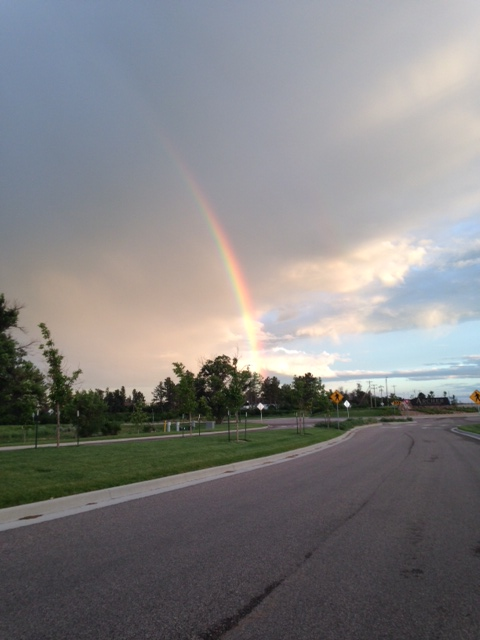
Dolly Parton was born on January 19, 1946. A quote attributed to her is this: “The way I see it, if you want the rainbow, you gotta put up with the rain.”
If you are walking through a stormy and difficult time in your life, I want to encourage you to look for the rainbow. God is present in the midst of our sorrow and pain. The sun will shine again.