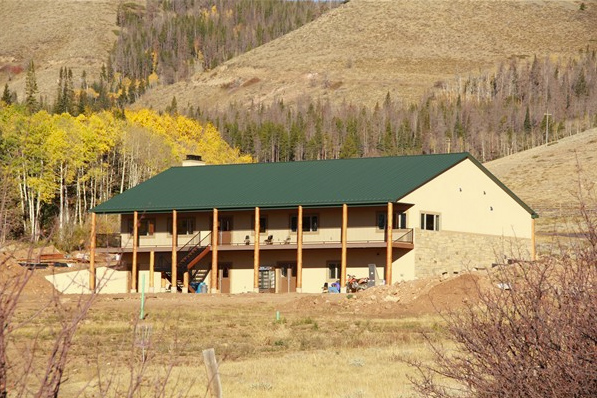
Four out of the last five years I have had the opportunity to make a retreat at the Abbey of St. Walburga in Virginia Dale, Colorado as a participant. I am excited to now have the pleasure of leading a women’s retreat at the abbey. The date has been set for Saturday, September 20, 2014.
This will be a small gathering with a maximum of 20 retreatants. Registration details will be forthcoming in local parish bulletins, but I want to encourage women in the Cheyenne, Pine Bluffs, and Laramie areas to give some thought to joining us for this day of retreat. Cheyenne and Laramie residents can reach the abbey in approximately 60 minutes of travel. If you have never been to the abbey, I highly recommend it. Of course, the sisters will welcome you into their gift shop while you are there.
Although the picture I have used is from one of my previous retreats, I am hoping there will not be snow on the ground in September. However, you never know.
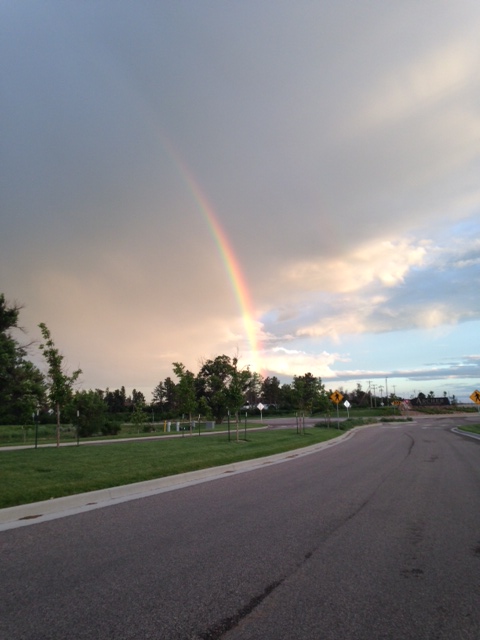
Although the camera didn’t capture the brightness of the rainbow quite as well as I had hoped, the scene was simply breath-taking yesterday evening. The weather has dealt the region a few harsh blows in recent days with hail, torrential rain, and even a tornado or two, but the beauty of God’s handiwork is also quite noteworthy.
Early this morning I opened a couple of windows in the house and the cool, crisp air quickly lowered the inside temperature to 60 degrees. It was refreshing and invigorating. I din’t get to do that very often in late June when I lived in Missouri. I generally got up and lowered the thermostat so the air-conditioner would kick on. (It’s cheaper just opening a window. I’m all for that.)
I hope you have the opportunity to enjoy some relaxation time during the weekend. It is hard to believe we will enter the month of July on Tuesday.
Next week I will share some thoughts on freedom and independence in the light of our faith. I am waiting to see what decisions are handed down by the U.S. Supreme Court on Monday in regard to the HHS Mandate. The verdict which is expected to be announced on Monday in regard to Hobby Lobby and other organizations under consideration will give a glimpse into the future of religious liberty in our country. If the decision goes against religious liberty, the ripple effect will take effect immediately on Tuesday, July 1, 2014. Other cases currently being heard in appellate courts across the country will be impacted by the Supreme Court decision. It will be interesting to see the direction our country goes.
“This is the day the Lord has made. Let us rejoice and be glad in it!”
“Take my yoke upon you and learn from me, for I am gentle and humble in heart, and you will find rest for your souls.” (Matthew 11:29) On this Solemnity of The Most Sacred Heart of Jesus we are clearly reminded of the boundless love of God. Let us embrace that love with our whole heart, mind, soul, and strength.
We are less than two months away from the Wyoming Catholic Men’s Retreat being held in Centennial, Wyoming from August 22—24, 2014. You can visit the website to learn more details and register for the event. http://catholicmensretreat.org/
The opportunity to step away from the rigors of day-to-day life to reflect and pray is a wonderful gift indeed. This weekend retreat in the picturesque setting of Centennial, Wyoming will provide such an opportunity. I invite and encourage men all across the state to give serious consideration to attending this retreat if possible. As the retreat leader for the weekend I take my role very seriously. I will do my best with the help of God’s grace and the power of the Holy Spirit to lead us into a profound encounter with Jesus Christ during these days.
Stir Into Flame the Gift of Faith will be the theme of the weekend. We will focus our attention on the magnitude of God’s love, the gift of salvation, and our life in Christ. We will also look at ways we can more fully open ourselves to receiving the gifts of the Holy Spirit and to truly grow in holiness each and every day of our lives. There will be times for quiet meditation, prayer, discussions, and of course, the celebration of the Sacraments. It is exciting to share the journey of faith together.
In an attempt to get your mind pondering, here are a few reflection questions.
1. What motivates you to put your faith in Jesus?
2. How has the Eucharist nourished you for mission?
3. How do you live the Beatitudes in a concrete and specific way?
4. What are the things in your life that you place before God?
5. What have been your personal struggles with prayer?
6. Whom do you need to forgive at this moment of your life?
It is going to be a fantastic retreat. I am looking forward to gathering with men from all across the diocese.
As a side note—LADIES—I was approached yesterday about leading a women’s retreat this fall. I have agreed to do this and plans are underway. It looks like it will just be a day long retreat rather than a weekend retreat because of the limited availability of dates at the Abbey of St. Walburga in Virginia Dale, Colorado which is the desired location for the retreat. As the date and times are finalized I will share the information with you.
Modern society has more than its share of social and political upheavals. Psalm 46 offers some significant reflections for leaders in the midst of these upheavals. Verse 10 (or verse 11 depending upon the translation of the Bible being used) extends a direct invitation to us. “Be still and know (confess) that I am God!” Psalm 100 verse 3 reiterates this command. “Know that the Lord is God, our maker to whom we belong, whose people we are, God’s well-tended flock.” As I ponder these verses I also recall that we have been purchased at a great price. (1 Corinthians 6:20)
Is it not wonderful to know that we belong to God? There is great comfort and solace in realizing that our names have been engraved in the palms of God’s hands. (Isaiah 49:16) Is this a gift we too easily take for granted? There are questions I need to seriously pose to myself regarding my ability, or lack thereof, to sit quietly before the Lord. Do I truly seek out solitude and quietness for meditation and prayer? Do I allow God to speak to me in the depths of my heart, or am I frantically doing all of the talking during my prayer? How disciplined am I at simply being still?
It is fascinating to review Psalm 46 in the light of the extreme actions that are detailed. I studied several different translations and the selection of words highlight the dramatic action to a lesser or greater degree depending upon the translation. One rendition says, “…he lifts his voice, the earth melts.” Another version says, “God’s voice thunders and the earth trembles.” The thundering voice of God and the earth melting are some images that can be etched into my mind. What happens when I place those images along-side the invitation, “Be still and know that I am God?” This definitely opens the door to, “Come and see the works of the Lord.” (Psalm 46: 8 or 9)
I want to encourage you to find a place to sit quietly before the Lord. This can be in your room at home, in a church, outside in the beauty of God’s creation, or another place of your choosing. Let the magnitude of God’s love permeate every fiber of your being. Let the agitation of daily cares and worries slip away. Allow the grace of God to move within you. TRUST that you have been wonderfully made and give God thanks and praise! (Psalm 139:14)
Feel free to share any of your profound prayer experiences in the comment section for others to read.
Praying the Liturgy of the Hours for the last 20 years has been an interesting experience. There are times when the psalms especially speak to me in regard to life circumstances and other times when they do not. However, there is one psalm that always makes me pause a little longer than the others, and that psalm occurred this morning. It is Psalm 90 verse 10 in particular. “Seventy is the sum of our years, or eighty, if we are strong; most of them are sorrow and toil; they pass quickly, we are all but gone.”
This passage is very sobering. The human frailty we experience in our day-to-day lives is a reality that is spelled out quite succinctly in this one verse. The following verses of the psalm add a piece of hope as the prayer continues. Verse 12 says, “Teach us to count our days aright, that we may gain wisdom of heart.” Verse 17 concludes the psalm with, “May the favor of the Lord our God be ours. Prosper the work of our hands! Prosper the work of our hands!”
How blessed we are when we gain wisdom of heart! That gift doesn’t automatically come with the passing of the years. It is a gift given to us through the love and favor of God if we are open to grace. The power of the Holy Spirit in our lives gives meaning to the toil and helps bring forth an abundant harvest of fruit. “…the fruit of the Spirit is love, joy, peace, patience, kindness, generosity, faithfulness, gentleness, self-control.” (Galatians 5:22)
Yesterday, my mom started questioning me about a recent post on my blog concerning the aspect of feeling defeated. She asked if I was sick or if something else was wrong. I didn’t know the answer to that question exactly when she asked it because there wasn’t one specific thing wrong. It was more a compilation of a variety of issues. Today, I know the answer to her question, and it is articulated in Psalm 90 verse 10. Life is just difficult at times.
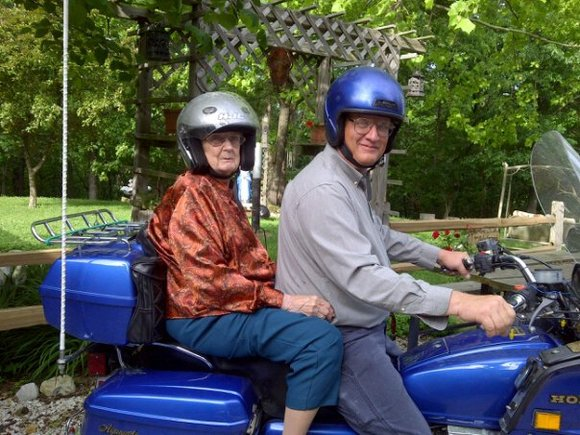
In closing, I would like to point out that my mom doesn’t have a computer and did not see any of my blog postings until a couple of weeks ago. Then, my nephew shared the post of my ordination anniversary on June 5, with her so she could see the pictures and the story. Now a friend of my mom’s has picked up the role of sharing my blog with her on a more regular basis. Since my mom will now be evaluating each word I write, I will simply give her a “shout out” this one time for surpassing the numerical expectations of Psalm 90. Mom, you not only made it past 70 and 80 years respectively, but have surpassed it by a decade. Thus, the picture above is just for you. Do you remember doing crazy things like riding a motorcycle in your 80’s? It makes me wonder. What did you do when you were younger?
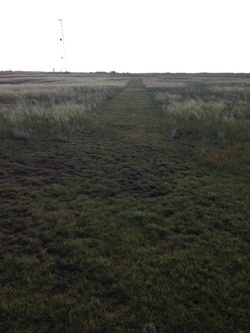
How do you interpret Isaiah 40:3? “In the wilderness prepare the way for the LORD; make straight in the desert a highway for our God.” Specifically, what is our role in building up the Kingdom of God? Do you ever wish the path in life was laid out so neatly that it would be almost impossible to get lost? It certainly would make it easier at times. However, even if the path appears to be clearly marked and prepared, there are still potential obstacles along the way. A little cactus growing close to the ground is enough to penetrate through soft-soled shoes. A rattlesnake lurking just off the beaten pathway can bring quite a startle to the unaware passerby. Little potholes created by animals or weather conditions can strain the unsuspecting ankle with one misstep. Quite simply, the path is never completely free of obstacles and potential dangers.Are we going to live our lives in fear of what could go wrong, or are we going to embrace both the joys and struggles of life with vigorous hope? Will we live the adventure that has been graciously bestowed upon us? Sometimes there are clouds and sometimes the sun shines brightly. Sometimes we get both at the same time. The blessings of God can be seen in all.
As I get older and find it more and more difficult to sleep uninterrupted through the night, I realize that I have taken a lot of things for granted through the years. The ability to sleep peacefully is one of those things. I can remember back to my teenage years when it would take a lot to stir me from a deep sleep—even twelve hours into it. Those days are obviously long gone.
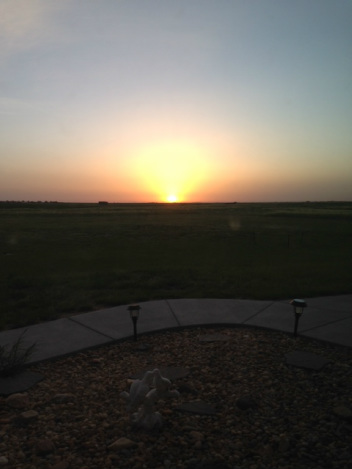
This morning was one of those times when I woke up prior to 5:00 A.M. I quietly went into the dining room where I could sit and pray without disturbing others and watch the sun gently rise over the horizon. Although I am typically not a “morning person” and would prefer to watch a sunset as opposed to a sunrise, the opportunity to witness this marvelous component of sacred order to our existence was just what I needed today. A few events in recent days had led me to feel a bit on the discouraged side and that is a downward spiral I try to avoid if possible. I would not have expected to see the virtue of hope just after 5:00 A.M., but it is hard to feel defeated in life when you witness the magnificence of the Creator in a beautiful sunrise.
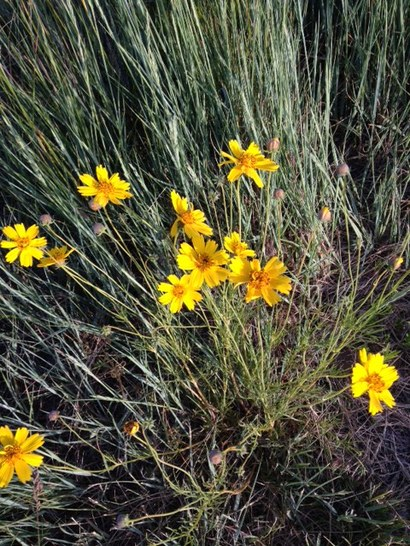
The challenges and struggles of life are present for each of us. Some people I know are carrying huge burdens of suffering. God blessed me this morning with a powerful reminder of the magnitude of His love and His power. Whatever cross we find ourselves currently enduring, it is my prayer that we embrace it with the certainty of God’s love in our midst. Take time to enjoy a beautiful sunrise or sunset, or at least stop and smell the flowers.
What is your world view? As you look at the basic beliefs that form your world view, where do you land in regard to the contemporary Culture War? The culture war is simply a clash of beliefs in regard to what is true. There is no doubt that these ideas as they pertain to moral values have certainly shifted in recent decades.
The categories or topics which fall into the realm of the culture wars are many. We can start from the beginning and pit the Theory of Evolution against Biblical Creationism. Furthermore, did we start with a Big Bang or is the creation narrative told in the Book of Genesis the accurate account? If we move into the topic of sex we can take many side roads to explore. Alfred Kinsey certainly played an instrumental role in lowering inhibitions. The resulting consequences are rampant premarital sex, marital infidelity, divorce, contraception, abortion, and the mainstreaming of homosexuality. How acceptable has this behavior become in our society?
Gallup conducted research from May 8—11, 2014 about morality by asking the question, “Do you believe that, in general, the following are morally acceptable?” Here are some of the results Gallup released:
Birth Control 90%
Divorce 69%
Sex between an unmarried man and woman 66%
Having a baby outside of marriage 58%
Gay or lesbian relations 58%
Doctor-assisted suicide 52%
Abortion 42%
Pornography 33%
Sex between teenagers 30%
Married men and women having an affair 7%
The statement I hear more and more frequently from Christians is that we have lost the culture war. Traditional beliefs are no longer the majority opinion in society and the subsequent consequence is a loss of the freedom of religion. If you don’t believe that freedom of religion is being taken away in the process of the persistent sexual indoctrination, ask the bakers who refused to bake a wedding cake for a same sex couple wedding. Ask the businesses being forced to comply with the HHS mandate to provide contraceptives to their employees even though it contradicts their religious beliefs. The culture wars have exacted an immense toll on our country and the ripple effect is only beginning to be seen.
Someone asked me last week, “Where is the Church?” That is an interesting question. Obviously, there have been times when Church leadership has probably failed to teach effectively the fullness of the Truth. There may have been times when the Gospel message was watered down to make it more palatable to the hearers. Human failures in being faithful to the proclamation of Jesus Christ can be traced back all the way to the apostles. This is nothing new. It is also nothing new for members of the Church to ignore the teaching of the Gospel and to reject the moral guidance of the Church. It is called “free will.”
There is plenty of blame to go around for those of us who believe that American society is in steep moral decline. Pointing fingers and accusing others of being the problem will not help us reach a solution as to how we are going to turn the tide. Let’s face the facts. American society has accepted the culture of death as the mainstream of life. It sounds like a contradiction in terms. However, if we look seriously at the Gallup results there is no denying that the statistics point predominantly toward death. Let’s take a look at some of the topics listed above and ask the question, “Is it life giving?”
Birth control may be looked upon as an avenue of freedom to enjoy sexual relations without the “consequences” of a resulting pregnancy. Is it life-giving? Certainly not! It is strategically designed to prevent life from emanating through the conjugal act. This is not freedom. It has simply given license to use people as objects for the purpose of self-gratification. The shocking component of this is that 90% of people apparently agree that this is okay. The resulting promiscuous behavior (made possible by the pill) repeatedly brings heartache and devastation into the lives of many people. The sadness and brokenness is frequently palpable.
Divorce has taken a huge toll on our society. If you have experienced a divorce yourself, or walked the journey of healing with someone else who has divorced, you understand the consequences of this action. There is enough pain and suffering in the process of a divorce to last a lifetime. This does not just impact the husband and wife who are parting ways, but the traumatic and emotional impact on the children is nothing short of heart-wrenching. The bitterness and anger that frequently accompanies the divorce process has a ripple effect on the extended family as well? Is this life-giving? Certainly not! Yet, 69% of people think this is a morally acceptable thing to do.
I was grateful to see lower numbers (though still too high) in regard to the acceptance of pornography (33%) and sex between teenagers (30%). Sexual promiscuity is apparently okay as an adult if you are not viewing pornography. Sex between an unmarried man and unmarried woman is acceptable by 66% of those surveyed. Unfortunately, the lack of commitment and stability that is evident in the “hook-up” culture has some long-term effects for the stability of society. Pregnancy outside of wedlock (58% think it is acceptable), higher likelihood of poverty, and other social concerns are intertwined to the noncommittal nature of these types of relationships. Is it life-giving to have a high percentage of adults engaging in sexual relations outside the bond of marriage? Some would argue that it is. Birth control has obviously encouraged that point of view. Looking at the procreative and unitive component of the Sacrament of Marriage in the context of Christianity would express a very different point of view.
Abortion has been viewed as a major aspect of the culture war since 1973. According to Gallup 42% of respondents think abortion is acceptable. This is something I will never understand. As ultrasound technology continues to improve and we get a clearer and clearer picture into the womb, it is beyond my comprehension as to how society has become okay with snuffing out the innocent life of a child. An ultra-sound guided abortion is what prompted abortion clinic (Planned Parenthood) director Abby Johnson to become pro-life. In her testimony she reveals the horror she experienced as she watched (via ultra-sound images) the baby struggling to escape the suction machine designed to terminate the pregnancy. These images reveal clearly more than a “blob of tissue” or a “fetus”. The jargon or terminology concocted will never conceal the fact that it is a baby present in the womb of the mother. We have allowed the discussion about abortion to be hijacked by those with a very specific agenda. Pregnancy became a disease to be cured rather than a miracle of life to be celebrated. Is abortion life-giving? That seems like a pretty easy question to answer, and yet, 42% are morally okay with this horrendous procedure. How many lives have been lost through abortion? How much heartache and grief has been experienced by the parents after the fact?
It has become politically correct to be in favor of gay and lesbian relations. If a person dares to disagree with this lifestyle, he/she will be immediately taken to task. We not only have to be tolerant of this lifestyle, we have to condone and even celebrate it. If we choose to speak against it as morally unacceptable, we are labeled as engaging in hate speech. The owners of the bakery in Colorado were hauled into court for not compromising their values and refusing to provide a “wedding cake” for a same-sex couple. Business executives and owners have suffered severe repercussions for not embracing and celebrating the gay and lesbian lifestyle. If we look at gay and lesbian relations from the point of view of natural law, it is difficult to even phrase the question, “Is the relationship life-giving?” Some would obviously argue that it is, but if we look honestly at the nature of the relationship and the biological make-up of a man and a woman, it would be very difficult to prove the physical life-giving component of the relationship. However, 58% are okay with that.
What does this mean for today’s Christian? It means that we have allowed our church congregations to blend into society to such a degree that we have faded out of moral relevance. The secular culture is now dictating the moral values of society rather than the Church. Will the Church rebound from this dilemma and once again become a prominent player in the shaping of contemporary culture? I don’t know. One thing is for sure—the road ahead is not a smooth one.
Christians are going to experience a profound shift in what it means to be a follower of Christ. Blending into culture and fading out as a real influence from the Christian moral perspective is no longer an option. It is time for Christians to be a relevant and faithful witness to Jesus Christ. A comfortable Christianity does not exist in modern times. There will be a price to pay for following Christ, and we have already begun to see the beginnings of persecution. If the signs of the times are any indication, we are only in the early stages of a dramatic shift in our lifestyle.
Do you need other examples outside the sexual realm to believe this is happening? What will be the role of marijuana in society as it becomes legal on a more widespread basis? How does physician-assisted suicide or euthanasia impact the value of life? Who ends up determining the value of a life based upon its functionality? Will that be the role of government in making these determinations??
The moral and ethical questions are mounting almost on a daily basis. Frequently, it appears that all viewpoints are welcome into the conversation except those of the Christians. This Gallup poll reveals that we are in for some difficult days ahead. The martyrdom of Christians throughout history shows the price that is sometimes exacted for being a believer. We may have never considered that it could enter our time and location in history, but I think it is beginning to enter upon our doorstep. How will we respond?
Today begins the nine days of prayer between the “Ascension of Our Lord” and the “Descent of the Holy Spirit” at Pentecost. This is the original novena, and I am hopeful that we will not let these days pass by without imploring the Holy Spirit to refresh and renew the fire within us.
I would encourage you to read chapter 14 of John’s Gospel each day of this novena. Let these words of Sacred Scripture seep into the very depths of your heart and permeate every fiber of your being. Pay attention to verse 12 in particular. The question is, do you and I trust in the words of Jesus? If so, let’s live like we believe!
“Come, Holy Spirit, fill the hearts of your faithful. And kindle in them the fire of your love. Send forth your Spirit and they shall be created and You will renew the face of the earth. Lord, by the light of the Holy Spirit You have taught the hearts of Your faithful. In the same Spirit help us to relish what is right and always rejoice in Your consolation. We ask this through Christ our Lord. Amen.”